Types of Cheese Knives
Six shapes come in a typical set and three of them do almost all the work. Here is which is which, and what each one is actually for.
Heads up: we earn a commission from qualifying purchases made through the links on this page, at no extra cost to you. It never changes which products we pick or the order we rank them in. Full disclosure.
Quick picks
Tap any row to jump to the full write-up further down the page.
| # | Product | Best for | Score | Price |
|---|---|---|---|---|
| 1 | 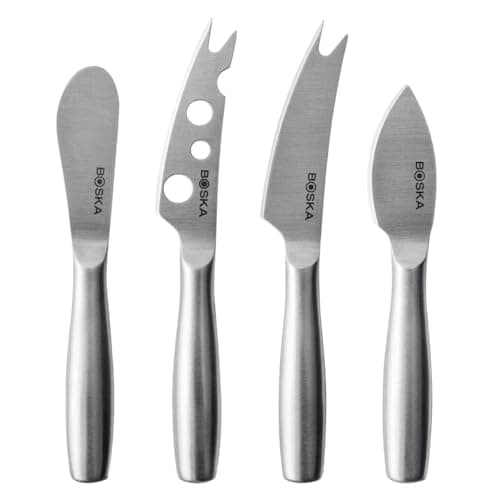 BOSKA Cheese Knife SetActually cutting cheese | Actually cutting cheese | 8.5 | $24.99 · View on Amazon #ad We may earn a commission · Price as of November 2, 2026 |
| 2 | 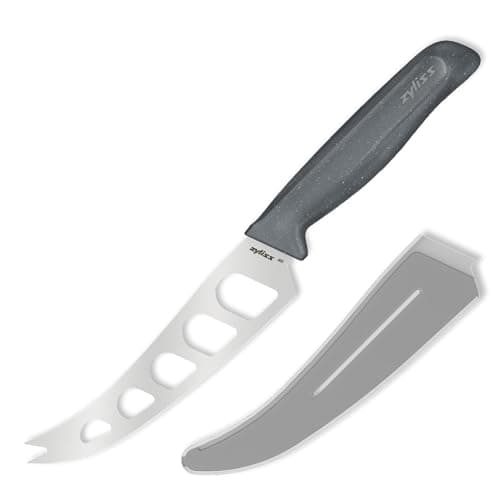 Zyliss Cheese Knife SetEveryday use | Everyday use | 8.1 | $12.66 · View on Amazon #ad We may earn a commission · Price as of November 2, 2026 |
| 3 | 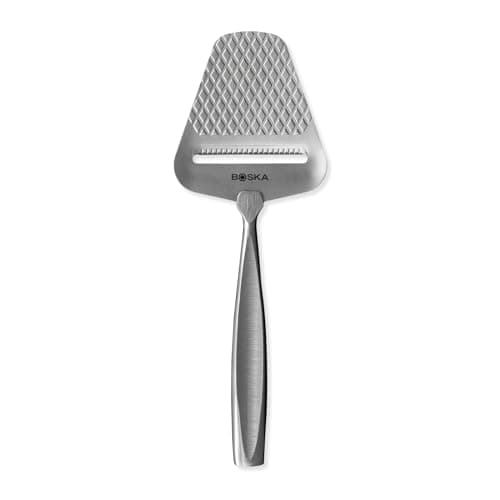 BOSKA Cheese Slicer Monaco+Even slices of hard cheese | Even slices of hard cheese | 8.1 | $19.99 · View on Amazon #ad We may earn a commission · Price as of November 2, 2026 |
| 4 | 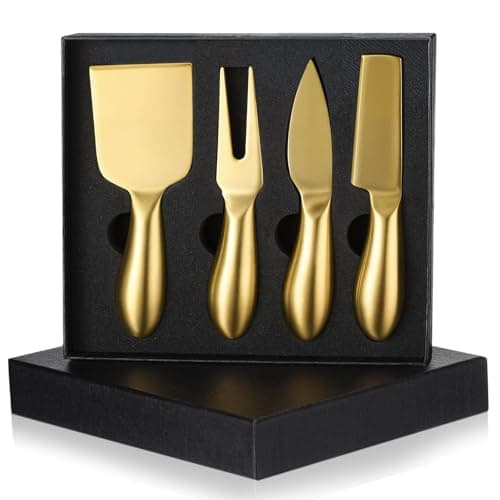 Funnymoom Gold Cheese Knife SetGifting | Gifting | 7.6 | $15.99 · View on Amazon #ad We may earn a commission · Price as of November 2, 2026 |
Scores are our editorial rating, not a lab test result — see how we pick.
There are six cheese knife shapes in common use, and the three that matter are the skeleton knife for soft cheese, the spade for hard cheese, and a flat spreader. Everything else in a set is either a serving tool or a shape built for one specific cheese. The reason the shapes differ at all is simple: soft cheese sticks to metal and hard cheese resists it, and no single blade handles both well.
The shapes, and what each one cuts
| Knife | How to recognize it | What it is for |
|---|---|---|
| Skeleton (holey) knife | Holes or long cutouts through the blade | Brie, camembert, young goat - anything that sticks |
| Forked-tip knife | Narrow blade ending in two prongs | Semi-hard cheese, then lifting the slice to a plate |
| Spade or trapezoid | Short, wide, chisel-like blade | Parmesan, aged gouda, cheddar - pushed, not drawn |
| Flat spreader | Blunt rounded blade, no edge | Fresh cheese, soft blue, anything butter-like |
| Narrow cleaver | Small rectangular blade | Cutting a block into slices or batons |
| Wire cutter | Handle with a taut wire instead of a blade | Mozzarella, fresh goat, anything that crumbles |
Soft cheese: the skeleton knife
Soft cheese fails in one specific way. A solid blade has enough surface area that the cheese grips it, so instead of parting the wedge you drag it, and the cut face tears. Cutting most of the metal out of the blade leaves narrow ribs doing the work, the contact area collapses, and the slice releases on its own.
That is the entire purpose of the holes, and it is why the skeleton knife looks like a mistake until the first time you use it on a cold brie. The alternative on very soft cheese is to stop cutting and start spreading.
Hard cheese: the spade, and when to use a slicer instead
Hard aged cheese needs force applied through a short, stiff blade. The spade is wide and chisel-shaped because you push down and lever rather than drawing a long blade across, which is how people end up snapping thin knives on parmesan.
If a household eats a lot of hard cheese off a block, a slicer is the better tool than any knife in a set. A plane-style slicer like the BOSKA Monaco+ takes an even sheet off the face and leaves it flat, so the next cut starts from a clean surface rather than a ragged one. The best cheese slicers roundup goes through the three designs - plane, handheld wire and wire-on-a-board - and which cheeses each one can actually cut.
The tools in a set that are not knives
- The forked-tip knife is really a serving tool. It cuts semi-hard cheese adequately and its actual job is lifting the slice you just cut, which is why it stays on the board.
- The pointed fork that comes in larger sets is for olives, cornichons and chunks of hard cheese. Useful, not a knife.
- The wire cutter is a specialist. It is excellent on fresh mozzarella and crumbly goat, and it does nothing a knife cannot do on anything firmer.
- The cheese plane shaves rather than cuts and suits semi-hard cheese on bread. It is the shape most households already own without knowing it is a cheese tool.
Steel, handles and what wears out
Cheese knives live an easy life — no bone, no hard chopping — so the steel matters less here than in a kitchen knife. Any decent stainless blade holds a usable edge on cheese for years. What fails is the join between handle and blade, which is why a set washed by hand lasts and a set put through a dishwasher with wooden handles loosens.
That is the one thing worth checking before you buy: if the set has wood, horn or decorated handles, plan on hand washing. The BOSKA and Zyliss sets on this page are both straightforward stainless, which is why they tolerate real use.
Which set to buy
- Best overall: the BOSKA set. German steel and blades genuinely shaped for cheese rather than scaled-down kitchen knives.
- Best for everyday: the Zyliss set. Japanese stainless blades around 5 in, dishwasher safe, and sized for a weeknight board rather than a spread.
- Best for hard cheese: the BOSKA Monaco+ slicer, used alongside a set rather than instead of one.
- Best as a gift: the Funnymoom gold-tone set, which arrives in gift packaging and covers spreader, fork, slicer and cutter.
The full roundup with scores is in the best cheese knives, and if the knives are going on a board you are also buying, the combined option is cheese board and knife sets.
How to lay them out on a board
Put each knife on or beside the cheese it is for, blade pointing in toward the center of the board and handle toward the edge. That sounds fussy and it is purely practical: a handle pointing out is one a guest can pick up without reaching across three other cheeses, and a blade pointing in keeps the business end off the table.
Soft cheeses get their knife resting on the wedge itself, because that is where it will end up anyway. Hard cheeses get theirs beside the block with a few pieces already cut, which is the single best thing you can do to make a board approachable — nobody wants to be the first person to cut into an untouched wheel.
If a board has more cheeses than knives, group by strength rather than by texture. One knife across three mild cheeses is fine; a blue or a washed rind needs its own regardless of how many knives that leaves for everything else. Where each cheese goes on the board is in how to build a charcuterie board.
The picks in full
We have not lab-tested these products. Picks are chosen from live listings, sustained customer feedback at scale, material quality and fit for hosting — our full methodology.
Product image from Amazon, refreshed daily.
1. BOSKA Cheese Knife Set
A specialist cheese company's knives rather than a board maker's afterthought. These go through a hard aged cheese, which is exactly where bundled knives fail.
Key specs
- German steel
- Cheese-specific blade shapes
- Sold as focused sets
What works
- Cuts hard cheese without the blade skating off
- Blade shapes are matched to cheese types, not decorative
- From a company that only makes cheese tools
What does not
- Costs more than the knives bundled with a board
- No wooden handle option in every set
#ad We may earn a commission · Price as of November 2, 2026
Product image from Amazon, refreshed daily.
2. Zyliss Cheese Knife Set
Japanese stainless blades from a kitchen-tool brand that has to stand behind them, and the set you reach for on a Tuesday rather than only for guests.
Key specs
- Japanese stainless steel blades
- About 5 in blades
- Dishwasher safe
What works
- Holds an edge better than bundled board knives
- Dishwasher safe, so they actually get used
- Comfortable handles for a full board's worth of cutting
What does not
- Plainer looking than the gold and wood-handled sets
- Fewer specialist shapes than a dedicated cheese brand
#ad We may earn a commission · Price as of November 2, 2026
Product image from Amazon, refreshed daily.
3. BOSKA Cheese Slicer Monaco+
A slicer rather than a knife, which is the right tool for a firm aged cheese people want in even pieces. The non-stick treatment is the difference between slices and crumbs.
Key specs
- Stainless steel
- BSF non-stick treatment
- 210 x 74 x 9 mm
- Dishwasher safe
- Lifetime guarantee
What works
- Gives consistent slices that a knife cannot match on a firm cheese
- Lifetime guarantee from a company that only makes cheese tools
- Works on cucumber and hard vegetables, so it is not single-purpose
What does not
- Useless on anything soft, so it never replaces a knife set
- The wire-free design means a dull blade cannot be swapped, only replaced under warranty
#ad We may earn a commission · Price as of November 2, 2026
Product image from Amazon, refreshed daily.
4. Funnymoom Gold Cheese Knife Set
Gold-finished spreader, fork, slicer and cutter that photograph beautifully on a board. A gift-first set, and honest about it.
Key specs
- Gold-tone finish
- Spreader, fork, slicer, cutter
- Gift packaging
What works
- Looks like a considered gift straight out of the box
- Covers the four cuts a board actually needs
- Gold reads well against dark wood and marble
What does not
- Finished tools want hand washing to stay looking new
- Edge quality is behind the specialist brands
#ad We may earn a commission · Price as of November 2, 2026
Common questions
What are the different types of cheese knives?
The common six are the skeleton or holey knife for soft cheese, the forked-tip knife for semi-hard, the spade or trapezoid for hard cheese, the flat spreader for anything butter-like, the narrow cleaver for cutting blocks, and the wire cutter for fresh cheese. Most sets ship three or four of these.
Which cheese knife is for soft cheese?
The skeleton knife - the one with holes or cutouts in the blade. The holes cut the contact area down so brie and camembert release from the steel instead of smearing along it. A spreader also works for anything soft enough to behave like butter.
Why do cheese knives have holes?
To stop soft cheese sticking. A solid blade pulls a sticky cheese with it and tears the wedge. Cutting most of the metal away leaves only narrow ribs touching the cheese, so it parts cleanly and slides off the blade.
What is the forked tip on a cheese knife for?
Serving, not cutting. Once you have cut a slice, the two prongs let you lift it onto a plate or a cracker without handling it. It is why the forked-tip knife is usually the one left on the board between slices.
How many cheese knives do you actually need?
Three: something for soft cheese, something for hard, and a spreader. Soft and hard cheese genuinely need different blades, and a spreader covers the third common case. Larger sets add convenience and the occasional cheese-specific shape, not capability.
Should each cheese on a board have its own knife?
Yes, one knife per cheese. It is less about the shape than about keeping flavors separate - a blue cheese knife carries blue onto the next wedge, and a honey-dipped spreader carries honey into everything. Two knives for three mild cheeses is a reasonable compromise.
Are cheese knives dishwasher safe?
The blades usually are and the handles are where it varies. Stainless blades with molded or steel handles generally go in; wood, horn and decorative handles should be washed by hand because repeated heat loosens the join between handle and tang.